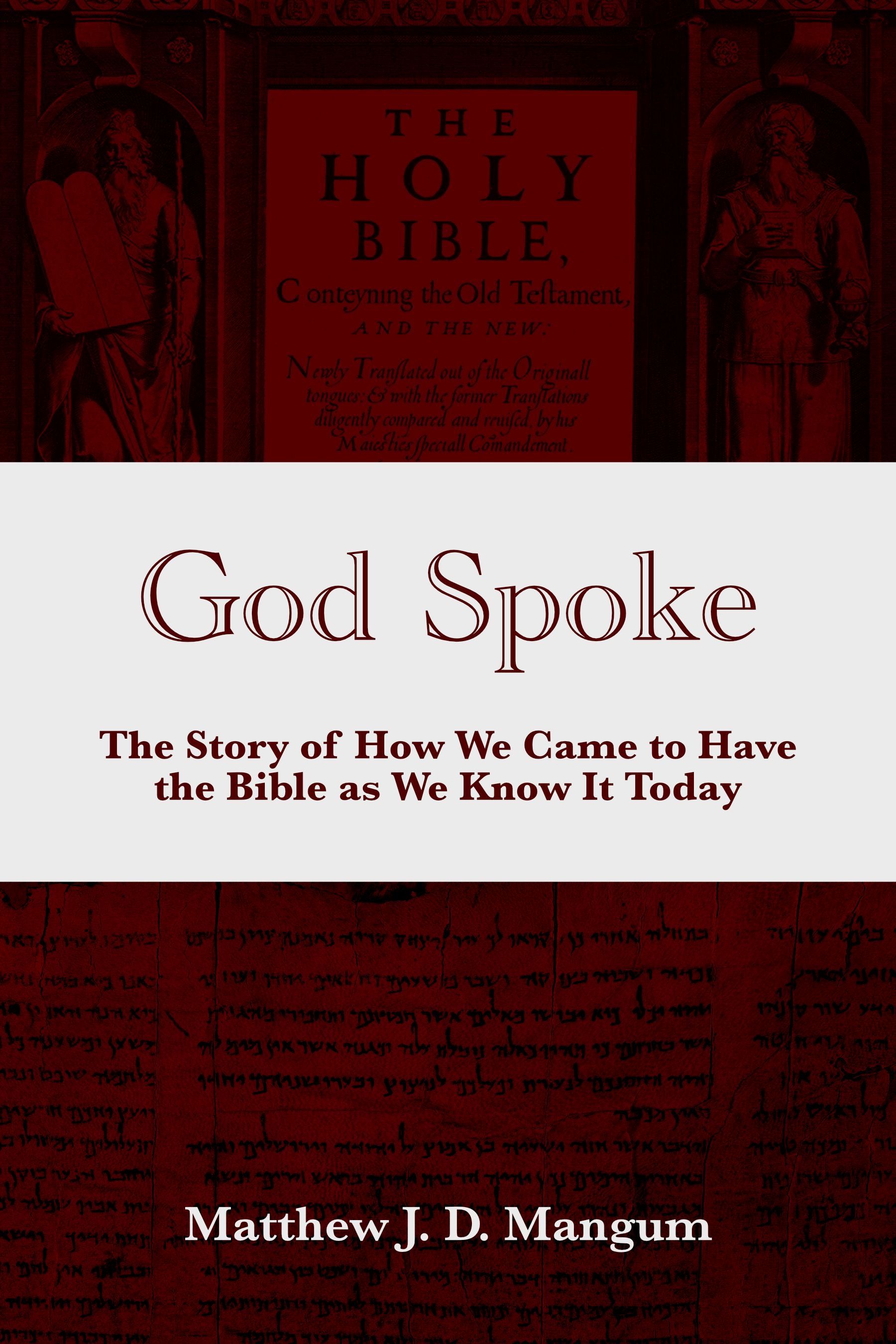
This year marks the 500 year anniversary of the publication of William Tyndale’s English New Testament, the very first English translation to be made directly from the Greek. In honor of the occasion, here is an excerpt from my book God Spoke: The Story of How We Came to Have the Bible as We Know It Today that briefly details the history of Tyndale’s translation and its legacy in subsequent translations.
William Tyndale’s Translation (1526)
John Wycliffe may be credited with inspiring the first complete English translation of the Bible, but pride of place in the history of the English Bible must go to William Tyndale (c. 1494–1535). A gifted linguist with proficiency in seven languages apart from his native English,1 Tyndale might truly be called the father of the English Bible. He was the first person to translate the New Testament into English based on the Greek, and the first to translate parts of the Old Testament from the Hebrew. Furthermore, his translation has had an enduring influence—though we may be largely unaware of it—and it has impacted most subsequent major English translations.
Tyndale, born around the year 1494, proved himself to be linguistically gifted from a young age, being able to “read Latin with ease” by the age of ten.2 This giftedness led to him attending Oxford at the age of twelve, graduating with his Bachelor of Arts in 1512, and then receiving his Master of Arts in 1515. From Oxford, Tyndale likely moved on to study at Cambridge until 1522, where the influence of Erasmus upon the study of Greek was very much alive. As Tyndale was coming of age and honing his scholarly pursuits, momentous goings-on were afoot: Erasmus helped revitalize interest and scholarship in Greek with his publication of the Greek New Testament in 1516, Martin Luther (unwittingly) began the Reformation in Germany in 1517, the Swiss Reformation under Ulrich Zwingli was in full swing by 1522, and Luther later published his German translation of the New Testament that same year. At some point during this upheaval, Tyndale embraced the ideals of the Reformation and came to the conviction that the Bible should be translated into the language of the common people. This conviction is best captured in his famous quotation preserved by John Foxe:
Soon after, Master Tyndall happened to be in the company of a learned man, and in communing and disputing with him drove him to that issue, that the learned man said: “We were better be without God’s law than the Pope’s.” Master Tyndall, hearing that, answered him: “I defy the Pope and all his laws”; and said: “If God spare my life ere many years, I will cause a boy that driveth the plow, shall know more of the Scripture than thou dost.”3
The Bible, in Tyndale’s estimation, should be available to everyone, even the lowly plowboy. It should be available to every ordinary man and woman on the street, so that the common people could read and learn the Scriptures themselves. Luther had recently given the German people the Bible in their own language, and Tyndale desired to do the same. In 1523, he sought an appointment from Cuthbert Tunstall (1474–1559), the Bishop of London, to translate the Scriptures into English, but Tunstall turned him down and tried to discourage him from pursuing the project. Tyndale instead found a willing patron in the cloth-merchant Sir Humphrey Monmouth, who allowed Tyndale to stay in his house for six months where he began the work of translation. The work in England would be short-lived, as Tyndale soon was forced to leave England if he was to continue translating; as he put it in his own words in his 1530 preface to the Pentateuch, he came to understand “at the last not only that there was no room in my lord of London’s palace to translate the New Testament, but also that there was no place to do it in all England, as experience doth now openly declare.”4 In spring of 1524, Tyndale left England for the continent, never again to return to his home country.
Tyndale conducted his translation work on the New Testament in exile in Germany, working from Erasmus’s third edition (1522) of the printed Greek New Testament. The New Testament was completed in 1525 and Tyndale entrusted the work of printing to Peter Quentell in Cologne, Germany. The first attempt at printing very nearly ended in disaster. The city authorities put a stop to Quentell’s printing and attempted to seize the translation materials, but Tyndale became aware and was able to escape up the Rhine to Worms (Germany) with some of his materials intact. A second attempt at printing was completed in 1526 by the printer Peter Schöffer, and copies were presently being smuggled into England. Forays into translating the Old Testament soon followed, with a translation of the Pentateuch published in 1530 and Jonah in 1531. These were the first translations of the Old Testament into English from the original Hebrew. Not content with the overall quality of his first translation of the New Testament, Tyndale issued revisions improving upon his translation in 1534 and 1535, the last of which would be the most enduring.
Translation is an inherently controversial matter, and Tyndale’s translation was especially so, not only theologically but also politically. Rather than using the familiar English ecclesiastical terms, he exchanged others that had different implications. Rather than “church,” he translated “congregation”; “senior” (and later “elder”) instead of “priest”; “repent” in place of “do penance”; “love” rather than “charity.”5 In each of these instances, Tyndale struck at aspects of the theology of the day and opened up new ways of understanding the text. His translation decisions raised the ire of various churchmen in England, most notably Thomas More. More charged “there is a false English translation of the New Testament newly forged by Tyndale, so altered and changed in matters of great weight.” These changes were such that More considered that the translation “was not worthy to be called Christ’s testament, but either Tyndale’s own testament, or the testament of his master Antichrist.”6 The translation, as well as Tyndale’s other writings, made him a hunted man for the remainder of his life.
It is hard to overestimate how influential William Tyndale has been, not only on the history of English Bible translations but also on the English language itself. He is credited with introducing to English or popularizing various words we take for granted as part of our theological vocabulary, such as “Passover,” “atonement,” “judgment seat,” and “Jehovah.”7 He is responsible for the familiar biblical turns of phrase, such as “let there be light” (Gen 1:3), “my brother’s keeper” (Gen. 4:9), “there were shepherds in the field abiding” (Luke 2:8), or “fight the good fight” (1 Tim. 6:16). Many words and phrases that we are accustomed to as part of the language of the Bible were first introduced to English by Tyndale, to the point that his translation work laid the foundation for all subsequent early English Bible translations, as well as many modern ones. It has been estimated that about 80–90% of Tyndale’s words are preserved in the King James Version (KJV), the single most influential Bible in the English language.8 If the shadow of the KJV looms large over most modern English Bible translations, the shadow of Tyndale looms large over the KJV.
Tyndale’s writings and translation work kept him on the run from those who sought his life, but he could not run forever. In 1535, the same year his final revision was released, Tyndale was betrayed by an associate and arrested by the authorities. He spent the rest of the year and much of 1536 in prison. His words from prison echo those of the apostle Paul:
I believe, most excellent Sir, that you are not unacquainted with the decision reached concerning me. On which account, I beseech your lordship, even by the Lord Jesus, that if I am to pass the winter here, to urge upon the lord commissary, if he will deign, to send me from my goods in his keeping a warmer cap, for I suffer greatly from cold in the head, being troubled with a continual catarrh, which is aggravated in this prison vault. A warmer coat also, for that which I have is very thin. Also cloth for repairing my leggings. My overcoat is worn out; the shirts also are worn out.9
Even in prison, wiling away his final days, he tried to continue his translation of the Old Testament: “But above all, I beg and entreat your clemency earnestly to intercede with the lord commissary, that he would deign to allow me the use of my Hebrew Bible, Hebrew Grammar, and Hebrew Lexicon, and that I might employ my time with that study.”10 We do not know if this request was granted, but the likelihood that he would have been allowed to continue translation in prison seems low. In August 1536, he was found to be guilty of heresy, and on October 6, he was brought out for execution. Tyndale was tied to the stake, first strangled, and then his body burned, dying a martyr’s death for his life’s work to give the English people the Bible in their own language. His final words were, “Lord, open the king of England’s eyes!” That prayer, though he may not have known it, was being answered even as Tyndale died.
The Coverdale Bible (1535)
Tyndale may have died, but English Bible translation did not die with him: forces were already at work in England to pave the way for widespread acceptance of English translations. King Henry VIII’s disputes with Rome over annulling his marriage to Catherine of Aragon ultimately led to his breaking with Rome in 1534. While he himself was not reform-minded, his battles with the Roman Catholic Church led to the elevation of figures who were Protestants. Notable among these were Thomas Cromwell, the king’s chief minister, and Thomas Cranmer, the archbishop of Canterbury. Through the influence and urging of these two men, as well as the December 1534 petition of the bishops, Henry was persuaded to allow for the Bible to be translated into English and placed in every church in England.
The man who was entrusted with producing this Bible was Myles Coverdale (1488–1559), an associate and friend of William Tyndale, who had in fact assisted Tyndale in preparing his translation. Next to Tyndale, Coverdale is the second-most influential individual in the history of English Bible translations. In 1535, he printed a translation of the complete Bible (including the Apocrypha)—the first to be printed in the English language. In his dedication, Coverdale said he had “with a clear conscience purely and faithfully translated this out of five sundry interpreters.”11 Who were these five interpreters? As it turns out, they were Tyndale, two German translations, and two Latin translations. Unlike Tyndale, Coverdale was proficient in neither Greek nor Hebrew and so he was forced to rely upon these other translations. The New Testament is essentially a revision of Tyndale’s work, while the Old Testament is translated out of the Latin and German. Coverdale’s usage of German resulted in him coining new terms for certain German words, such as “unoutspeakable” as an English equivalent of the German unaussprechlich. Yet he is also credited for having a good ear for English turns of phrase, being responsible for introducing such familiar words and expressions into English as “the valley of the shadow of death,” “lovingkindness,” and “cast me not away from thy presence,” to name a few.12
The translation appears to have been favored by Queen Anne Boleyn, and it is possible that this had some effect upon King Henry VIII. In any event, when another printing was run in 1537, it carried with it the king’s license. A year after Tyndale’s death, and the Bible was being printed in England freely with the king’s permission.
The Matthew Bible (1537)
The same year that Coverdale’s revised Bible was printed with the king’s license, another translation appeared under the name of Thomas Matthew also bearing the king’s license. Though the translation is remembered as the Matthew Bible, it was actually the work of John Rogers, published under the pseudonym of Thomas Matthew. The Matthew Bible was not a new translation; it was in fact largely the work of Tyndale. Tyndale was still a controversial figure, and could not yet be openly acknowledged, but the Matthew Bible is essentially the Tyndale Bible as far as he had completed it. Rogers incorporated Tyndale’s 1535 New Testament, as well as what was substantially Tyndale’s translation of the Pentateuch and his unpublished translations of the historical books up through 2 Chronicles. Those books that were never translated by Tyndale were supplemented by Coverdale’s Old Testament and Apocrypha. This was a remarkable turnaround for the work of Tyndale. As one historian has summarized the state of affairs,
Within twelve months of the martyrdom of its author [Tyndale] at Vilvorde, the translation which “either with glosses or without” had been denounced, abused, and burnt at St. Paul’s Cross, was now, under its assumed name, formally approved by the King’s grace, and published together with Coverdale’s Bible, under the shelter of a royal proclamation and license.13
Tyndale’s life’s work to bring the Bible to the people in the English language was now being realized openly, and that largely through his own translations. “It was a signal act of justice,” F. F. Bruce has commented, “ordinary justice and poetic justice too—that the first English Bible to be published under royal license should be Tyndale’s Bible… even if it was not yet advisable to associate Tyndale’s name with it publicly.”14 And the progression of the English Bible’s acceptance in the public life of England would continue to roll on.
The Great Bible (1539)
There was a need for a common Bible in the Church of England, but the Matthew Bible could not fit the bill. It contained many marginal notes explaining the text which were of a decidedly Protestant character, and this was not entirely to the liking of some of the clergy. Thomas Cromwell desired that a common Bible should be issued to the churches in England, and so he commissioned Myles Coverdale to revise the Matthew Bible in a version that contained no notes. The result of this revision was what history remembers as the Great Bible, so named for its rather large size (about 15 x 9 inches). The close relationship of English Bible translations continued, such that the Great Bible was, in effect, “Coverdale’s revision of John Rogers’ revision of Tyndale’s Bible, so far as Tyndale’s Bible went.”15 The new Bible was to be used in every church in England, and as such was the first authorized Bible in the Church of England.
The greatest impact of the Great Bible on the history of English Bibles was in its ordering of the books. Tyndale had followed the practice of Martin Luther of placing Hebrews, James, Jude, and Revelation at the end of the New Testament and marking the books without numbers, so that the New Testament books were numbered as 23, and the Coverdale and Matthew Bibles had followed the same practice. The Great Bible broke with this tradition and arranged the New Testament as Erasmus had done in his printed Greek text, and this is the ordering of the New Testament that comes down to us in the present. Coverdale’s translations of the Psalms were carried over into the Great Bible, and they were incorporated into the Book of Common Prayer in 1549 by Thomas Cranmer, where they remained in continuous use until the late twentieth century.
King Henry VIII was a volatile king, and his favor waxed and waned rapidly. Though he had allowed for the printing of three English Bible translations, he soon turned against some of them. Tyndale’s translation—that is, that which was identified by his name—was banned by an act of Parliament in 1543. Furthermore, this act forbade the public reading or expounding of the Bible, as well as banning the private reading of Scripture for lower classes of people. Following the 1543 Act of Parliament, Henry himself issued a proclamation that made it illegal to possess either Tyndale or Coverdale’s translations, and many of them were burned at St Paul’s Cross.16 The irony of the whole state of affairs is that the Great Bible remained the authorized Bible for the Church of England and it was still substantially Tyndale and Coverdale’s work; the burning of translations bearing their names hardly removed their influence from the land.
- Those others being Latin, Greek, German, French, Hebrew, Spanish, and Italian. David Daniell, William Tyndale: A Biography (New Haven & London: Yale University Press, 1994), 18. Daniell’s biography of Tyndale is an excellent resource for both the life of Tyndale and his translation work. ↩︎
- Bobrick Benson, Wide as the Waters: The Story of the English Bible and the Revolution It Inspired (New York: Penguin Group, 2002), 80. ↩︎
- John Foxe, Actes and Monuments (London: Day, 1563), 514. Spelling modernized. ↩︎
- “Tyndale’s Preface to the Pentateuch, 1530,” in Gerald Bray, Translating the Bible: From William Tyndale to King James (London: The Latimer Trust, 2010), 51. Bray is an excellent resource as he provides prefaces to all of the early English Bible translations in a single volume. ↩︎
- F. F. Bruce, History of the Bible in English: From the Earliest Versions, 3rd ed. (New York: Oxford University Press, 1978), 41. ↩︎
- Thomas More, Book 4 of The Confutation of Tyndale’s Answer, in The Complete Works of St. Thomas More, vol. 8, part 1, ed. Louis A. Schuster, Richard C. Marius, James P. Lusardi, and Richard J. Schoeck (New Haven, CT: Yale University Press, 1973), 358. Spelling modernized. ↩︎
- David Teems, Tyndale: The Man Who Gave God an English Voice (Nashville, TN: Thomas Nelson, 2012), xx. See also Benson, Wide as the Waters, 258. ↩︎
- For the 80% estimate, see John Nielson and Royal Skousen, “How Much of the King James Bible Is William Tyndale’s? An Estimation Based on a Sampling,” Reformation 3, no. 1 (1998): 49–74. For detailed discussions of Tyndale’s translation work as a whole, see Daniell, William Tyndale, 134–142, 302–332. ↩︎
- J. I. Mombert, William Tyndale’s Five Books of Moses Called the Pentateuch: Being a Verbatim Reprint of the Edition of M.CCCCC.XXX (New York: Anson D. F. Randolph & Co, 1884), li. The original Latin is also printed alongside the English translation. ↩︎
- Mombert, William Tyndale’s Five Books of Moses, li–lii. ↩︎
- “Coverdale’s Dedication and Preface to the Bible, 1535,” in Bray, Translating the Bible, 67–68. ↩︎
- For more samplings of Coverdale’s memorable words and phrases, see Bruce, History of the Bible in English, 62–63 and Gordon Campbell, Bible: The Story of the King James Version 1611–2011 (New York: Oxford University Press, 2010), 16–17. ↩︎
- H. W. Hoare, Evolution of the English Bible: A Historical Sketch of the Successive Versions From 1382 to 1885, 2nd ed. (London: John Murray, 1902), 186. ↩︎
- Bruce, History of the Bible in English, 65. ↩︎
- Bruce, History of the Bible in English, 70. ↩︎
- Bruce, History of the Bible in English, 78–80. ↩︎