If you have studied the transmission of the Bible to any extent, you will have become familiar with the idea of textual variation. That is, amongst the manuscripts of the Bible that have been handed down through the centuries, there are differences known as textual variants. While the vast majority of variants are easily dismissed as spelling and nonsense errors, there is still a reasonably large number that may be considered “meaningful and viable” variants, that is, variants that change the meaning of the text in some way and that have a good chance to be original. It is entirely possible that after learning about textual variation, you may be asking yourself, if there is so much textual variation in the Bible, even if much of it is minor, how can we say that we still have the Word of God?
Ehrman’s Challenge
If textual variation means that the text is no longer the Word of God, well that would imply that we never truly ever had it since all manuscripts differ. It is just this sort of idea that Bart Ehrman very often promotes. Ehrman grew up in what appears to have been a fundamentalist Christian background and seems to have taken an all-or-nothing approach to the Bible. He studied at Moody Bible Institute, and then at Wheaton College, and finally at Princeton Theological Seminary. During his studies, he began to learn about the text of the New Testament and of the textual variation that exists amongst the manuscripts, and this caused him to abandon the faith of his youth and to eventually become an agnostic. In his book Misquoting Jesus, Ehrman describes how this study led him from fully believing in the inerrancy of Scripture to fully repudiating any notion of the divine origin of the Bible:
I kept reverting to my basic question: how does it help us to say that the Bible is the inerrant word of God if in fact we don’t have the words that God inerrantly inspired, but only the words copied by the scribes—sometimes correctly but sometimes (many times!) incorrectly? What good is it to say that the autographs (i.e., the originals) were inspired? We don’t have the originals! We have only error-ridden copies, and the vast majority of these are centuries removed from the originals and different from them, evidently, in thousands of ways.1
He continues by laying out the theological implications he drew from all of these errors and variations in the copies of the New Testament:
This became a problem for my view of inspiration, for I came to realize that it would have been no more difficult for God to preserve the words of scripture than it would have been for him to inspire them in the first place. If he wanted his people to have his words, surely he would have given them to them (and possibly even given them the words in a language they could understand, rather than Greek and Hebrew). The fact that we don’t have the words surely must show, I reasoned, that he did not preserve them for us. And if he didn’t perform that miracle, there seemed to be no reason to think that he performed the earlier miracle of inspiring those words.2
Ehrman essentially seems to have exchanged one form of fundamentalism for another, and he carries forward the same assumptions: the copies of the New Testament must be absolutely perfect, or else the Word of God does not exist or can never be known. If all manuscripts differ to one degree or another—and they do—does that mean that God has not preserved his word? If there is uncertainty at certain points in the texts of our Bibles—and there is—does that mean that we cannot speak with certainty of anything of the message of Scripture? Ehrman and others like to suggest that such conclusions follow, but that is simply not the case. If all we are focused on are the minutia of specific words, it is very easy to see how we could end up in a morass of doubt. But take a step back and look at the bigger picture. Ask yourself, have the differences in the text changed the meaning and message of Scripture? Do you come away with vastly different ideas of who God is and the way of salvation if you read the NKJV and then read the NIV? I would certainly hope your answer is no; if your answer is yes, I would be curious as to why. The entire macro-picture of the message of Scripture remains intact: there is one God who is the creator of heaven and earth; there is one Lord, Jesus Christ, who was conceived by the Holy Spirit, born of the virgin Mary, who was crucified, died, and was buried, and who rose again from the dead on the third day; there is forgiveness of sins in Christ; there is a new covenant made in his blood; there is the promise of the Holy Spirit; there is one Lord, one faith, one church, one baptism, one God and Father of all. This and much more. The message is exactly the same. Sure, there may be some places where passages cannot be used to support a doctrine (e.g., 1 John 5:7–8) or have slightly different nuances, but the central doctrines of the Christian faith do not rest on a single passage. I would be willing to bet that even in the most (unintentionally) error-ridden manuscript of the New Testament, the message it communicates is not corrupted.
The Testimony of Erasmus
Now the idea that textual variation undermines the authority of Scripture is not a new charge. It is one that Erasmus faced and answered in his day with his Greek text and his attempts at restoration of the Latin. While his words are now over five hundred years old, they are well worth quoting at length here:
Now, should there be any who fear that, if a change is anywhere introduced, the authority of sacred literature will be called into question, they should know that already for a thousand years the manuscripts, whether Latin or Greek, have not agreed in every respect. Agreement would not, in fact, be possible, given not only the large number of copyists but also their ignorance, carelessness, and indiscretion – not to mention the many alterations made by the semi-educated or, at least, the inattentive.3
He appeals to ancient history:
Already in his day Origen complained about puzzling variations in the Gospels. In their public liturgies the Greek church reads one text, the Western church another. About the time of Jerome, some churches were following the Septuagint translation, while some were embracing the new translation made from the original Hebrew. Even later than this, the churches of Gaul were reading one text, the churches of Rome another. Finally, if you inspect the old manuscript codices that were used in those times in public worship, you will scarcely find two that agree with each other. Certainly it is clear that Augustine used manuscripts that were not free from faults. And yet all down through the centuries the authority of Scripture has stood firm. If textual variation in the manuscripts completely deprives the Scriptures of their reliability, then, remember, there is manuscript variation in the Hebrew, in the Greek, and in the Latin.4
He cuts to the heart of the matter of whether the ravages of time corrupt the authority of Scripture:
I wholeheartedly support those who preach the inviolable authority of the divine Scriptures. One who knowingly corrupts them insults the Holy Spirit. I acknowledge this. But the sovereignty of Scripture lies in the originals themselves. Isaiah did not err, nor does anyone try to alter what he wrote. Matthew did not stumble; no one corrects what he recorded. Our concern is with the translators, with the scribes, with the corruptors. But if all authority collapses because of a certain number of corrupt passages, the Holy Spirit ought to have attended the copyists as he did the prophets and evangelists. The Holy Spirit is present everywhere but exerts his force in such a way as to leave some of the work for us to do. That inviolable authority of Scripture stopped with the prophets and apostles or evangelists. But it is the great glory of Scripture that, although re-expressed so often in so many languages, so often mutilated or corrupted by heretics, contaminated in so many ways by the carelessness of scribes, it nevertheless retains the vigour of eternal truth. So the church, constantly shaken by all the storm winds of adversity, stands firm. But one who has, to the best of his ability, restored to its original integrity what human beings have corrupted serves the Holy Spirit.5
My wish, and I suspect everyone’s wish, would be the same as that of Erasmus: “I too would wish that in sacred literature nothing was corrupt, nowhere was there any disagreement. And yet, while it is easy to wish for this, it never has been the fact, nor, I think, ever will be.”6 Disagreement between manuscripts is the situation that God has given us. We must acknowledge that it is God who has left us with the reality of textual variation, and we must approach the matter according to the reality that God has established. We do not want to set up a standard (i.e., absolute textual certainty) that does not accord with what God has done. Just as we must perform the task of interpreting Scripture, so too must we interpret the manuscript evidence to determine what best preserved Scripture closest to its original form. God did not see fit to perfectly protect his Word against scribal errors, and so we have work to do to evaluate the copies. Yet God sufficiently preserved his Word. We have not been left without a witness, for the Scripture always and indeed “retains the vigour of eternal truth.”
Conclusion
The vicissitudes of the copying process impact us in the present, and we feel its effects in the textual differences that exist in our Bible translations. If you have ever been in a Bible study where people had different Bible translations, it will not take long to realize that there is some variation between them. Some of these units of variation can be difficult to sort out, while others are relatively straightforward. Yet for all the differences we may find, most are minor and would likely escape our notice but for someone pointing them out. We should approach these differences with our eyes wide open and not hide them. We should freely acknowledge them in the confidence that the Word of God is sufficiently preserved, and that even in these differences, the Word of God stands firm and its message remains clear.
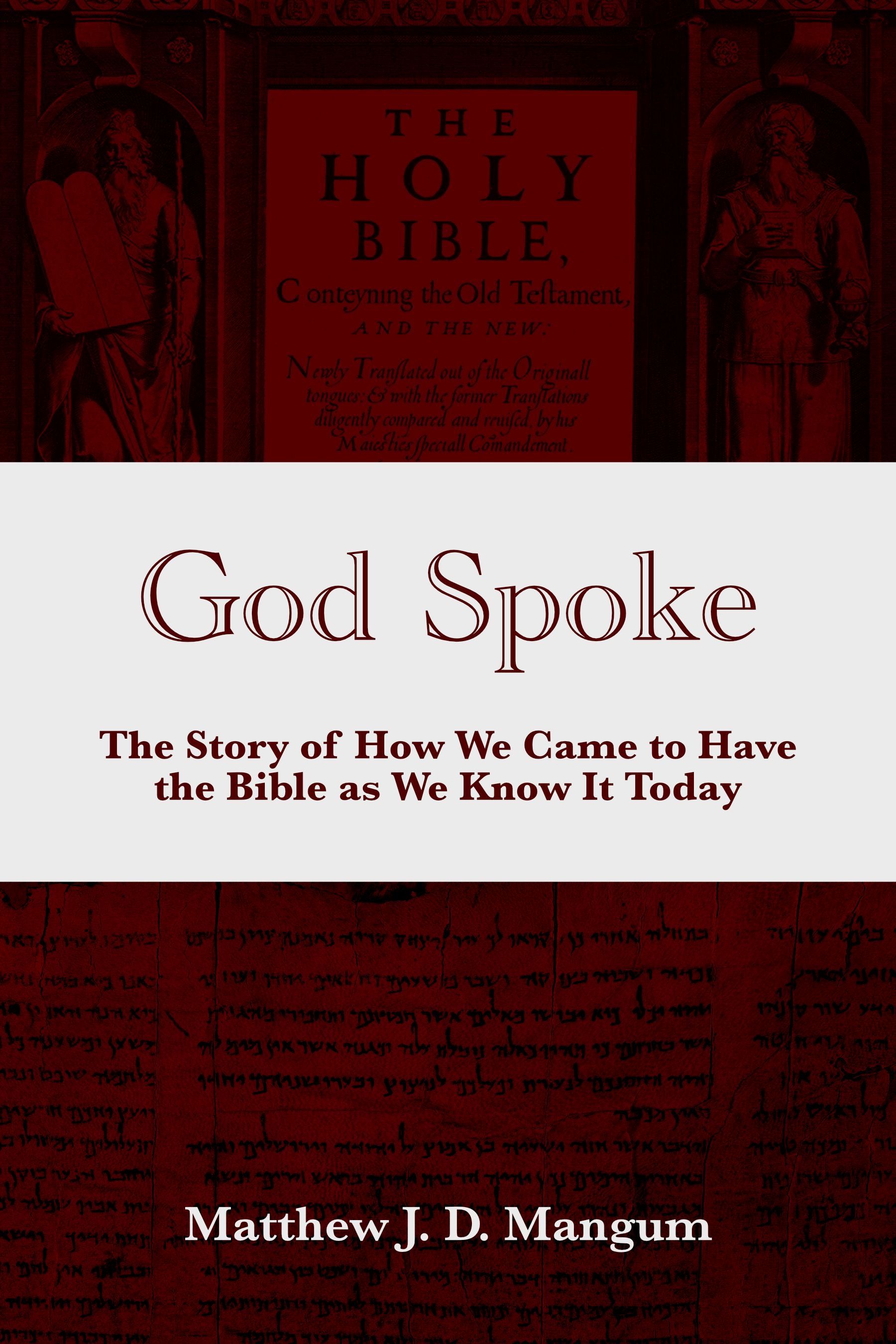
Adapted from “How Textual Variation Impacts Us Today” in God Spoke: The Story of How We Came to Have the Bible as We Know It Today.
Notes
- Bart D. Ehrman, Misquoting Jesus: The Story Behind Who Changed the Bible and Why (New York: HarperOne, 2005), 7. ↩︎
- Ehrman, Misquoting Jesus, 11. ↩︎
- Desiderius Erasmus, “The Apologia of Desiderius Erasmus of Rotterdam,” trans. John M. Ross, in The New Testament Scholarship of Erasmus: An Introduction with Erasmus’ Prefaces and Ancillary Writings, ed. Robert D. Sider, vol. 31, Collected Works of Erasmus (Toronto: University of Toronto Press, 2019), 462. ↩︎
- Erasmus, “Apologia,” 464–465. ↩︎
- Erasmus, “Apologia,” 467–468. ↩︎
- Erasmus, “Apologia,” 467. ↩︎